


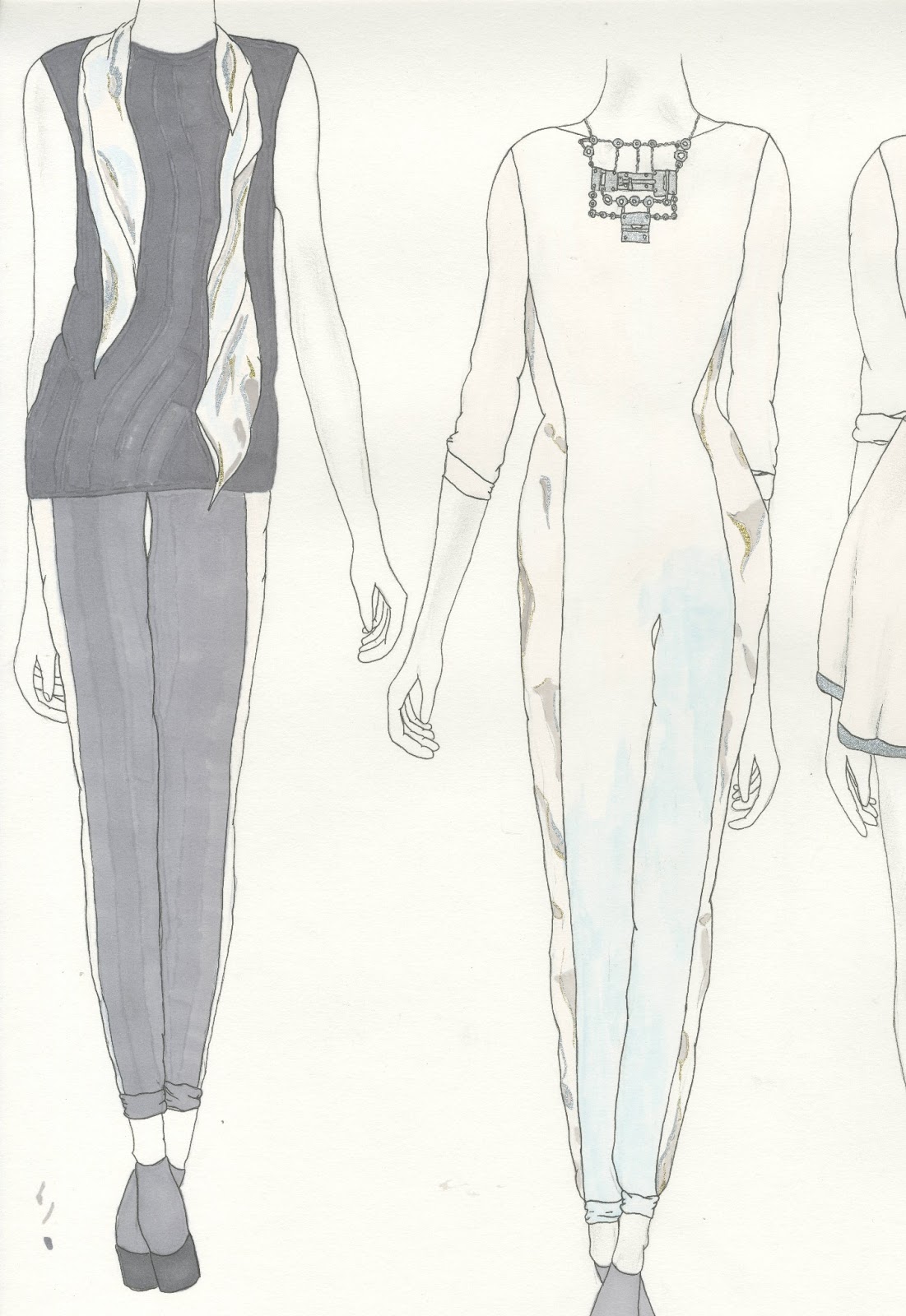
After getting the shape and movement of the garments right, I decided to display and present them with my prints applied onto them, thus providing another way of showing how my prints would appear when made into a garment.

 I wanted to work in a different style after successfully creating a series of drawings displaying full garments. I wanted to display my prints and embellishment samples through a fashion illustration so I again began with a drawing of a face (see left).


 The first textile world that I was a part of was construct. I particularly enjoyed the knitting aspect of the construct world and now whilst in TD4F I decided to reapply my knitting skills to my project.
 The sample featured on the left, shows a technique called "hooking up". This allows for some textures and buckles in the fabric and I decided to work into this with the embellishment techniques that I had developed before. This presented a new set of challenges in itself. The beads had to be carefully applied to ensure that they would stay on the right side of the fabric which turned out to be quite the nuisance. Regardless, I decided to work in the same way into the sample left, embellishing around the lace holes.

